General Manager, CMO or CEO are the most common. I’d also add that I’ve seen a fair number of Product Marketers leave the corporate world to become entrepreneurs. The kinds of people that are drawn to Product Marketing often have some of the same skills that will help them as an entrepreneur. Lastly, I’d just say it’s often such a fun, strategic and full of learning role, it can prepare you well in a lot of different career paths you choose. I know a former Product Marketer that became a press secretary for a presidential candidate! Choose your own adventure!
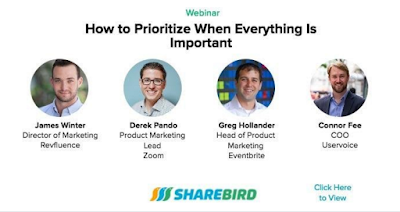
This will be a short one. Yesterday I spoke on a panel of Product Marketers trying to answer the question....How to Prioritize When Everything Is Important. It was a lot of fun, there were some great responses form the other panelists and great questions from the audience. Enjoy!
There is a plethora of articles advocating ambitious young people to join fast growing start ups to accelerate their careers. Here is a great example from the muse. One thing that always bothered me is how hard it was to find these companies, especially near where you live. I think I've found the most simple and straightforward way to do it. I must warn you, this does require a LinkedIn Sales Navigator license, but it could save you a lot of time. It's at least worth a free trial.
1. Use a website like this one to figure out all the zip codes that would be in the area you'd be willing to work. For example, if you don't want to commute more than 30 minutes, you should find all the zip codes within a 30 minute drive.
2. Log into Sales Navigator, hit the magnified class at the top, then select accounts on the left hand side.
3. Select the region drop down and pick by zip code.
4. Add the zip codes you'd be willing to work in, separated by commas
5. Then scroll down to the company growth slider and put it to your preferred %, my recommendation is 20% and up.
You'll now have a list of fast growing companies where you live. You can add other filters like company size, or industry to narrow down even further.
I hope this helps you find the kind of companies you're looking for, best of luck!
The first of December last year my boss’s boss came up to me and said, “hey, I’d like a new demo video for our sales kick off in a few weeks, can you make one?.” I was very excited for the challenge and also terrified since the timeline was tight and included the Christmas holiday. Long story short is that I was able to pull it off and make a video that has been received well and I’m proud of. There were a few things I learned along the way that I thought I’d share.
Get crystal clear goals and constraints. Know the exact timeline, exact budget and what you’re trying to accomplish. Don’t get started until it’s all mapped out. Reiterate the goals and constraints to everyone you talk to internally and externally, especially when the timelines are tight you need to reiterate over and over again to be able to move fast. Misunderstandings just slow you down.
Find inspiration. Look at as many example as possible. Decide which ones you like and which ones you don’t. Make stakeholders pick or rank their favorite ones out of a list you send them. An agency making your video will work best when you can give them a mashup and say something like “I want the style of this video, but the storyline of this one.”
Decide who gives feedback. One of the most challenging parts of the process can be managing everyone’s opinion. Decide who has the final word, then the other role people will play in the decision. Don’t have too many cooks in the kitchen.
Keep it short. No one watches long videos anymore. Don’t make it long, <90 seconds.
Let creative people be creative. If you’re using an agency, you are probably the domain expert, but lean on your agency when you need to. You don’t always have to tell them “how” to do something, but sometimes if you give them the “what”, they’ll figure out the how.
Show it to fresh eyes. Especially when you have your first version, show it to someone who is not involved in the process to get their reaction. If you’re too close to it, there will be so much you’ll miss. If you want your video to have broad appeal, show it to someone who is not in your industry or profession to really see if it’s simple.
Ok, let me tell you a bit about how this process went for me recently in the context of these tips.
1. The time was the big constraint, so when my executive wanted to do live action, after talking to the agency I just had to say NO. We just did not have enough time. Also, he made it clear the goal was for this to be exciting and pump up our sales team, but also to be used as a marketing asset throughout the year. He did not want a boring video. Those guidelines were our north star.
2. There were so many types of videos that I send him a few examples of the different varieties. This is the email I sent. It anchored the conversation in real world examples.
3. At LinkedIn we follow the RAPID framework and I had that mapped out and documented ahead of time. Not only that but there were some people we would usually get feedback from that we cut out of the process since they would slow it down.
4. This was hard for us. My executive kept wanted to include more and more pieces. We cut a lot and found a few creative ways to simplify the video. For example, instead of showing the Email, CRM and Mobile integrations, like he originally wanted, we just quickly mentioned they exist, which is what most people care about anyways. It saved us a ton of time.
5. There were some parts of the first draft that just did not work, but I did not have any idea, I went to the agency and they figured it out.
6. We were pretty happy with the video then we showed it to a bunch of fresh eyes and they said it was way too fast and they could not keep up. I also showed it to my wife and she said the same thing. We cut a bunch more, slowed it down until my executive’s kids got what we were trying to do.
So here it is....
Bottom line, it was a fun project and I learned a lot. A big thanks to Alchemy for helping me make the video.
It got me thinking about some common Product Marketing Interview questions. I've interviewed a good number of product marketers during my time at LinkedIn. Here are a few common ones.
1. Questions to see where your skill set really is within product marketing. It's hard to really understand what kind of product marketing someone has done until you start asking them questions.
2. Questions to test your product and industry expertise.
3. Questions to test your communication skills. I've said it often that your ability to communicate internally and externally is what makes or breaks a PMM.
4. Questions to test your strategic thinking. It's a very strategic position. If you click on the Quora link above I share one of my favorite case questions.
"Nice work on this one." That was the five word
email that made not just the day, but the week of a friend of mine. He's a
young patent attorney who writes patents for major tech companies in Silicon
Valley. His client was not known for lavish praise or lengthy emails and he
sent that five word email to him just after finishing up a patent application.
That email alone would have probably been enough to put a smile on his face
that day, but what really made the difference was that when he got that email his
boss was also copied on it.
Not only did he feel the gratification knowing that his
client was happy with his work, he looked good in front of his boss, the person
who arguably has the most impact on his ability to grow and advance in his
career at his firm.
In the United States we are about to celebrate Thanksgiving.
This holiday creates many reminders to say thanks. In my family on Thanksgiving
day, we all go around the table before we eat and say what we are grateful for.
While I’ll admit that most of the things discussed at the table are on a
personal level, this holiday can be an opportunity for you to express
appreciation to those in your professional life as well.
In the professional world one of the most impactful and
underrated ways you can say thank you at work is to not just direct it at the
person to whom you are grateful, but to send it to their direct manager. Here
are three tips on how to do this.
Be specific. Don’t just say “thanks for a great year.”
Highlight a specific project or a moment where you were particularly grateful
for their help.
Thank the boss as well. While you might be primarily
grateful for the work or help from a specific employee their boss can take at
least a little bit of credit. You can say something like. “I wanted to thank
you for all the hard work your team put in on this project, I’d like to
specifically call out the work on the part of the project that Sue did, she
really knocked it out of the park.”
Say thanks for the little things too. Don’t wait for some
massive milestone to be hit. At that point they’ll probably be getting thank
you’s and praise from all over the organization. Look for the quiet, unsung
tasks that can be so critical but often go unnoticed.
If you do this, these emails will be cherished by those that
receive them. Don’t be surprised if they even end up in their performance
evaluations as well.
While you're craving turkey and feeling the holiday spirit,
take a few minutes, write an email and make someone’s day, week or even month
by saying thank you.