Showing posts with label Job search advice. Show all posts
Showing posts with label Job search advice. Show all posts
Friday, April 24, 2020
Post MBA Career Decisions: Big Tech or Late Stage Startup

Wednesday, December 5, 2018
How to Get a Job at Zoom
I joined Zoom in April 2017. At that time, Zoom was still flying pretty below the radar as a great place to work. In fact, I only found out about it because of a friend who encouraged me to take a close look at them. Those days are over though, the secret is out. Today Glassdoor released it's top companies to work for and Zoom is #2 for large companies on a list among many other great well known companies. If seeing the Glassdoor report makes you think you'd like to explore working at Zoom, here are a few tips to help you get a job at Zoom.

1. Do your homework on the culture. Zoom has a very strong culture that Eric, our CEO and the whole executive team works to cultivate it. Watch his interviews on YouTube, his keynote from Zoomtopia and read articles he's written to get a sense of our culture. This will help you in the interview process.
2. If you know a Zoomer, ask them to refer you. Zoom has a robust internal referral process, so if you know someone at Zoom who will vouch for you, make sure to ask them to refer you. That will help make sure you get a good look.
3. Use the product. If you're not already super familiar with Zoom, you can download a free full featured version on Zoom.us and experience it yourself.
4. Video interview like a pro. Most interviews will be over Zoom, make sure you use computer audio or VoIP, turn your camera on and for bonus points use a virtual background.
Hope this helps and I get to see you around Zoom HQ soon. :)

1. Do your homework on the culture. Zoom has a very strong culture that Eric, our CEO and the whole executive team works to cultivate it. Watch his interviews on YouTube, his keynote from Zoomtopia and read articles he's written to get a sense of our culture. This will help you in the interview process.
2. If you know a Zoomer, ask them to refer you. Zoom has a robust internal referral process, so if you know someone at Zoom who will vouch for you, make sure to ask them to refer you. That will help make sure you get a good look.
3. Use the product. If you're not already super familiar with Zoom, you can download a free full featured version on Zoom.us and experience it yourself.
4. Video interview like a pro. Most interviews will be over Zoom, make sure you use computer audio or VoIP, turn your camera on and for bonus points use a virtual background.
Hope this helps and I get to see you around Zoom HQ soon. :)
Tuesday, April 10, 2018
How to Pick a Late Stage Startup to Work For: Lessons From Year One at Zoom
This post was first written on LinkedIn's publishing platform.
Today is my one year anniversary at Zoom. A year ago I left a job I really liked, working on a great product, in company with a pretty stellar culture and took a bet on a late stage startup.

There is a lot of conventional career wisdom, especially in the valley, that late stage startups are the place to be to accelerate your career. I'd been thinking about working for a later stage start up for years. Especially since the last two companies I worked for were public with 5,000+ employees when I joined.
It sounds easy, but it's really tough to pick the right one. In the valley, you see a lot of people leave big amazing companies for smaller companies, only to last less than a year, then return to another big company.
Looking back on this past year, I realize that some advice I got during my search for a late stage startup guided me to a place that I could thrive. If you're thinking about joining a later stage startup, here are a few things to look for that might help you find your next move.
A culture that runs deep. Lot's of companies claim to have a great culture, but I'm talking about finding a place where employees really live and breathe it. A big indicator for me was reading interviews of Zoom's CEO, Eric Yuan. After reading a few it was clear that culture was important to him and that he was working hard to cultivate a great culture from the very top. Glassdoor reviews is a great place to get a feel for the culture. My favorite source though is calling former employees. While looking into Zoom I called a former intern and asked her what she would change and she just complained a bit about some construction that was going on at the office, that was it.
A product that captures hearts and minds. My first reaction when I looked at Zoom was, "Video conferencing? What more can be done? There are a million products." It did not sound exciting, but I decided to do my homework. I read reviews of the product on third party review sites like TrustRadius and G2Crowd. I then looked at what people were saying on Twitter about Zoom and it became clear something special was going on. Even in a crowded market, if you find something that is winning the hearts and minds of consumers, jump on it.
Growth. Growth. Growth. If there is growth, it creates so many career opportunities. In the past year I've had essentially three different roles, competitive product marketing, running a user conference and international marketing. It has been challenging but I feel like I've learned so much is a very short period of time. The easiest way to find fast growing companies is to look at their headcount growth which you easily track on LinkedIn. A lot of good things can happen when a company is growing. If you can be picky, pick growth.
Especially in the valley, you have a lot of options of late stage startups to join. I hope these tips guide you to a place that you can thrive. Also, if you think that place where you can thrive might be Zoom, please reach out. :)
Today is my one year anniversary at Zoom. A year ago I left a job I really liked, working on a great product, in company with a pretty stellar culture and took a bet on a late stage startup.

There is a lot of conventional career wisdom, especially in the valley, that late stage startups are the place to be to accelerate your career. I'd been thinking about working for a later stage start up for years. Especially since the last two companies I worked for were public with 5,000+ employees when I joined.
It sounds easy, but it's really tough to pick the right one. In the valley, you see a lot of people leave big amazing companies for smaller companies, only to last less than a year, then return to another big company.
Looking back on this past year, I realize that some advice I got during my search for a late stage startup guided me to a place that I could thrive. If you're thinking about joining a later stage startup, here are a few things to look for that might help you find your next move.
A culture that runs deep. Lot's of companies claim to have a great culture, but I'm talking about finding a place where employees really live and breathe it. A big indicator for me was reading interviews of Zoom's CEO, Eric Yuan. After reading a few it was clear that culture was important to him and that he was working hard to cultivate a great culture from the very top. Glassdoor reviews is a great place to get a feel for the culture. My favorite source though is calling former employees. While looking into Zoom I called a former intern and asked her what she would change and she just complained a bit about some construction that was going on at the office, that was it.
A product that captures hearts and minds. My first reaction when I looked at Zoom was, "Video conferencing? What more can be done? There are a million products." It did not sound exciting, but I decided to do my homework. I read reviews of the product on third party review sites like TrustRadius and G2Crowd. I then looked at what people were saying on Twitter about Zoom and it became clear something special was going on. Even in a crowded market, if you find something that is winning the hearts and minds of consumers, jump on it.
Growth. Growth. Growth. If there is growth, it creates so many career opportunities. In the past year I've had essentially three different roles, competitive product marketing, running a user conference and international marketing. It has been challenging but I feel like I've learned so much is a very short period of time. The easiest way to find fast growing companies is to look at their headcount growth which you easily track on LinkedIn. A lot of good things can happen when a company is growing. If you can be picky, pick growth.
Especially in the valley, you have a lot of options of late stage startups to join. I hope these tips guide you to a place that you can thrive. Also, if you think that place where you can thrive might be Zoom, please reach out. :)
Saturday, February 17, 2018
One More Tip for MBA Students LinkedIn Profiles
A few weeks ago I was interviewed by the Financial Times asking for me to share some advice on how MBA's can leverage LinkedIn to get a job. There is some great advice in the article, not just from me. I recommend you check out the article here.
There is one piece of advice that they did not publish from me or anyone else they interviewed. If you can, make sure that you share examples of your work on your profile.
This can come in a lot for forms. Here are a few examples.
-Link in your profile to a news article about a product you worked on
-Post a YouTube video of something you have recorded that's work related
-Post something you've written for work. It could be a blog post, writing sample or anything in-between.
Look at how my friend and former classmate Nathan Tanner does it on his profile.

People will be able to see what you can really do and get a much deeper understanding of your skills and abilities.
You might be saying, "What I do can't be put on my LinkedIn profile...". To that I say, dig deep. There is always something.
There is one piece of advice that they did not publish from me or anyone else they interviewed. If you can, make sure that you share examples of your work on your profile.
This can come in a lot for forms. Here are a few examples.
-Link in your profile to a news article about a product you worked on
-Post a YouTube video of something you have recorded that's work related
-Post something you've written for work. It could be a blog post, writing sample or anything in-between.
Look at how my friend and former classmate Nathan Tanner does it on his profile.

People will be able to see what you can really do and get a much deeper understanding of your skills and abilities.
You might be saying, "What I do can't be put on my LinkedIn profile...". To that I say, dig deep. There is always something.
Monday, July 3, 2017
Want to find an inspirational leader to work for? Ask this question.
I originally published this post on Linkedin
My first job out of college was working for Salesforce. (I know, I lucked out big time, but that’s another story) My boss’s boss was a VP named Bill Macaitis. Everyone working for him really respected and admired him. Every few weeks he would swing by my desk and ask me “What can I do to make you happier? Is there anything you need? How can I help?”. He is one of the most inspiring marketing executives I’ve worked for not just because he cared, but he also got the job done. He went on to be the CMO of Zendesk, then Slack.
I did not know how good I had it at the time. A few jobs later, I know now that it’s very hard to find people like that to work for. Luckily, there is one question you can ask in the interview process that will give you a really good idea of how inspirational an executive might be to work for.
The question is “does anyone work for this executive now that has worked for them in the past?”.
Inspirational leaders are followed. In Bill’s case, I know people that have worked for him for the past four companies in a row he has worked for. At my current company Zoom, when our founder Eric Yuan left Cisco Webex to start Zoom he had 40 engineers follow him. I’ve seen this play out over and over again, especially in Silicon Valley.
I’ve also seen executives who manage very large organizations, even hiring a lot of people, that never seemed to attract people that had worked with them previously. Now, I’m not saying that every executive that has never had a repeat employee is bound to be terrible. There are lots of reasons why that might be the case; being young in your career, staying at a company for a long time, relocating and a lot of other factors could impact the likelihood that an executive is followed from company to company. I can assure you though that if a leader has been followed by former employees to multiple companies, there is something special going on.
Life is too short to work for people that do not inspire us, I hope this question makes it a little easier for professionals to find leaders to work for that inspire them. Also, with enough sleuthing around LinkedIn, you can probably figure out if an executive has been followed without even having to ask.
My first job out of college was working for Salesforce. (I know, I lucked out big time, but that’s another story) My boss’s boss was a VP named Bill Macaitis. Everyone working for him really respected and admired him. Every few weeks he would swing by my desk and ask me “What can I do to make you happier? Is there anything you need? How can I help?”. He is one of the most inspiring marketing executives I’ve worked for not just because he cared, but he also got the job done. He went on to be the CMO of Zendesk, then Slack.
I did not know how good I had it at the time. A few jobs later, I know now that it’s very hard to find people like that to work for. Luckily, there is one question you can ask in the interview process that will give you a really good idea of how inspirational an executive might be to work for.
The question is “does anyone work for this executive now that has worked for them in the past?”.
Inspirational leaders are followed. In Bill’s case, I know people that have worked for him for the past four companies in a row he has worked for. At my current company Zoom, when our founder Eric Yuan left Cisco Webex to start Zoom he had 40 engineers follow him. I’ve seen this play out over and over again, especially in Silicon Valley.
I’ve also seen executives who manage very large organizations, even hiring a lot of people, that never seemed to attract people that had worked with them previously. Now, I’m not saying that every executive that has never had a repeat employee is bound to be terrible. There are lots of reasons why that might be the case; being young in your career, staying at a company for a long time, relocating and a lot of other factors could impact the likelihood that an executive is followed from company to company. I can assure you though that if a leader has been followed by former employees to multiple companies, there is something special going on.
Life is too short to work for people that do not inspire us, I hope this question makes it a little easier for professionals to find leaders to work for that inspire them. Also, with enough sleuthing around LinkedIn, you can probably figure out if an executive has been followed without even having to ask.
Wednesday, April 26, 2017
How to Find Fast Growing Companies near Where You Live
There is a plethora of articles advocating ambitious young people to join fast growing start ups to accelerate their careers. Here is a great example from the muse. One thing that always bothered me is how hard it was to find these companies, especially near where you live. I think I've found the most simple and straightforward way to do it. I must warn you, this does require a LinkedIn Sales Navigator license, but it could save you a lot of time. It's at least worth a free trial.
1. Use a website like this one to figure out all the zip codes that would be in the area you'd be willing to work. For example, if you don't want to commute more than 30 minutes, you should find all the zip codes within a 30 minute drive.


1. Use a website like this one to figure out all the zip codes that would be in the area you'd be willing to work. For example, if you don't want to commute more than 30 minutes, you should find all the zip codes within a 30 minute drive.

2. Log into Sales Navigator, hit the magnified class at the top, then select accounts on the left hand side.

3. Select the region drop down and pick by zip code.

4. Add the zip codes you'd be willing to work in, separated by commas

5. Then scroll down to the company growth slider and put it to your preferred %, my recommendation is 20% and up.

You'll now have a list of fast growing companies where you live. You can add other filters like company size, or industry to narrow down even further.
I hope this helps you find the kind of companies you're looking for, best of luck!
Monday, December 29, 2014
How to Prepare for a Job Interview
In the last few month, I've interviewed a bunch of potential job candidates that are interviewing at LinkedIn for marketing positions. All these interviews have reminded me about what it takes to set yourself up for success in a job interview. In my opinion, here are some of the things you can do that the most successful job seekers do to prepare for an interview.

Look for warm connections. Check LinkedIn to see if you have mutual connections with the interviewers. If you do, make sure to mention the connection in the interview, especially if it's a strong contact. This will make you more memorable and encourage your interviewer to reach out to them to get their thoughts on you.
Research the company. Do you know what the company does? How they make money? What's the latest company news? Who is the CEO? I recommend in the days leading up to the interview that you set Google news alerts on the company. Also, reading the 10k, if it's a public company is a treasure trove of company specific information. Leverage Google search, social media and friends that you might have that work there to get as much information as possible.
Prepare questions to ask. The first rule of asking any question in an interview is don't ask any question where the answer can easily be found online. Try to ask questions that only that person could answer. Questions like, "why did you come to work here?" or "what do you like best about the culture?".
Research the interviewers. Google them and focus on professionally relevant information you might find. Look at their LinkedIn, Twitter and other social profiles to see what they have shared recently. Use all that information to help you think of better personalized questions to ask each interviewer. An example could be a question like, "I saw that you have an engineering background and started out in aerospace, but are now a product marketer. I've followed a similar path, do you think your engineering background has helped you here at XYZ company?"
Practice. Role play can feel cheesy, but your answers will be much better if you do a mock interview with someone else beforehand. Practice the stories you want to tell using the STAR stories format to keep them short and powerful.
Think about the question they will ask. There are many websites, like Glassdoor, where people will anonymously post questions they were asked in interviews at different companies. Read through the questions and practice answering the ones that you think you might be asked. Also, there are lots of website that compile common role specific questions.
If you're interviewing a lot, not all job interviews probably deserve this sort of preparation. A lot of preparation though, will make a big difference in how well you perform. If there is something you think I missed, please let me know in the comments!
Look for warm connections. Check LinkedIn to see if you have mutual connections with the interviewers. If you do, make sure to mention the connection in the interview, especially if it's a strong contact. This will make you more memorable and encourage your interviewer to reach out to them to get their thoughts on you.
Research the company. Do you know what the company does? How they make money? What's the latest company news? Who is the CEO? I recommend in the days leading up to the interview that you set Google news alerts on the company. Also, reading the 10k, if it's a public company is a treasure trove of company specific information. Leverage Google search, social media and friends that you might have that work there to get as much information as possible.
Prepare questions to ask. The first rule of asking any question in an interview is don't ask any question where the answer can easily be found online. Try to ask questions that only that person could answer. Questions like, "why did you come to work here?" or "what do you like best about the culture?".
Research the interviewers. Google them and focus on professionally relevant information you might find. Look at their LinkedIn, Twitter and other social profiles to see what they have shared recently. Use all that information to help you think of better personalized questions to ask each interviewer. An example could be a question like, "I saw that you have an engineering background and started out in aerospace, but are now a product marketer. I've followed a similar path, do you think your engineering background has helped you here at XYZ company?"
Practice. Role play can feel cheesy, but your answers will be much better if you do a mock interview with someone else beforehand. Practice the stories you want to tell using the STAR stories format to keep them short and powerful.
Think about the question they will ask. There are many websites, like Glassdoor, where people will anonymously post questions they were asked in interviews at different companies. Read through the questions and practice answering the ones that you think you might be asked. Also, there are lots of website that compile common role specific questions.
If you're interviewing a lot, not all job interviews probably deserve this sort of preparation. A lot of preparation though, will make a big difference in how well you perform. If there is something you think I missed, please let me know in the comments!
Thursday, October 23, 2014
No response to your request for an informational interview? Try this.
When I was an MBA student I reached out to a lot of busy professionals asking for a few minutes of their time for informational interviews. Even when it was a warm contact, not everyone was great about responding to my emails. As a busy professional before and after business school, I totally get it. Even when the intention is to respond, things happen. You forget, or even just deprioritize sending a response that day. There is though, a simple way to follow up that can help you eventually get some time on the calendar with most well intentioned busy professionals.

"Hope you had a great weekend. Let me know if any of these times work this week for a quick chat and what number to reach you at.
Monday- 9am-7pm
Wednesday- Anytime after 1pm
Friday- all day.Thanks,
Joe Schmoe"
That's it. Short and sweet. Following up in this manner is making it as easy as possible for them to reply. I personally don't think there is anything wrong with sending a similar email each week for a month. At that point you might want to try different tactics if you're still not getting a response, but as long as you keep it positive there is a good chance eventually you'll get a response.
Have another great tactic you use to follow up? Please share in the comments.
Friday, September 19, 2014
How to Get a Job in Product Marketing
 My first job out of college was a entry level web analytics role in the
online marketing group of Salesforce.com. My coworkers were amazing and
the company was growing like crazy, but after a year or so I realized
the role was not a great fit for me. I spent a few months shopping
different roles all over the company. Through conversations with product
marketers, and my own observations, it seemed that product marketing
was where I wanted to be. I was drawn to it because you get to be
strategic, creative, analytical and work on a variety of projects. After
a few failed attempts, I was able to transfer into my dream role in
product marketing.
My first job out of college was a entry level web analytics role in the
online marketing group of Salesforce.com. My coworkers were amazing and
the company was growing like crazy, but after a year or so I realized
the role was not a great fit for me. I spent a few months shopping
different roles all over the company. Through conversations with product
marketers, and my own observations, it seemed that product marketing
was where I wanted to be. I was drawn to it because you get to be
strategic, creative, analytical and work on a variety of projects. After
a few failed attempts, I was able to transfer into my dream role in
product marketing.Since I made the switch, I often get asked, "how do you get a job in product marketing?". To those of you that are thinking this might be a good fit for you in the future, I've mapped out a few of the common paths to a career in product marketing that I've observed in Silicon Valley.
Transferring within the company- It's not uncommon to get into product marketing from a different role within the company, just as I did. Most commonly this happens from within the marketing department, but I know several people that have come from roles as diverse as sales and PR.
Here is how David James, Director of Product Marketing at Lithium Technologies did it.
 "My career started in the agency world of public relations and advertising. A technology client hired me to come "in-house" as a marketing generalist. Overnight, I traded working alongside creatives, account services and traffic to collaborating with engineers, product managers and database admins. And I loved it. Slowly, I discovered there was a huge need in marketing to tell a compelling story -- but still know the product inside and out. It was the perfect marriage of marketing creativity and technology know-how.
 Bottomline: If you're in product marketing (or want to get there), know your product/service inside and out. Meet with product managers. Become their friends. Have a seat at the PM table and be the voice of the customer."
Going to business school- Product marketing is a popular post MBA job. Companies like HP, Intel, Adobe, LinkedIn and Google will take product marketing MBA interns for the summer. This can be a great way to get your foot in the door to a career in product marketing. Many of those same companies will often hire product marketing Managers right out of business school, even if they did not intern there.
Here is how Neal Armstrong, Sr. Product Marketing Manager at Symantec did it.
 "I came into B-School from
the finance industry with almost no marketing experience. To learn more
about product marketing I found a class that allowed students to
complete projects for local companies to earn class credits. There was a project focused on marketing with Adobe. My
credits were already maxed, but I joined the project anyways. Throughout
the project I found out more about how vital product marketing was to
an organization. I expressed my interest in continuing my work as a
summer intern. The Adobe employees I worked with on the project knew I was excited about working with Adobe and they personally recommended me. I had received other
internship offers from large tech companies outside of product marketing for the summer. After our final project was presented, the team manager and I
sat down and talked. At the end of our discussion, and with other
offers in hand, I secured my dream internship and was able to continue
my project as MBA Product Marketing intern."
"I came into B-School from
the finance industry with almost no marketing experience. To learn more
about product marketing I found a class that allowed students to
complete projects for local companies to earn class credits. There was a project focused on marketing with Adobe. My
credits were already maxed, but I joined the project anyways. Throughout
the project I found out more about how vital product marketing was to
an organization. I expressed my interest in continuing my work as a
summer intern. The Adobe employees I worked with on the project knew I was excited about working with Adobe and they personally recommended me. I had received other
internship offers from large tech companies outside of product marketing for the summer. After our final project was presented, the team manager and I
sat down and talked. At the end of our discussion, and with other
offers in hand, I secured my dream internship and was able to continue
my project as MBA Product Marketing intern." After some time in consulting- Lots of former consultants end up as Product Marketers, more often than not they had been consulting in a similar industry where they end of working. It's easier to get a product marketing job if you've established some domain expertise your future employer values.
Here is how Elizabeth Maples a Product Marketing Manager at LinkedIn did it.
 "I went back to get my MBA a few years ago, but I was one of
those “nontraditional” applicants: I’d been working on the editorial
side of book publishing, where I spent my time searching for new authors
to put under contract, and then working with them to turn an early idea
into a physical book (ah, the days of physical books!). Coming out of
business school, I knew I eventually wanted to get into (non-physical!)
media or technology, but still felt like I needed to build on the
strategic and analytical skills I’d learned in school. Consulting was a
phenomenal training ground—and gave me the chance to work at a number of
big companies in the industry. With that experience, I was much better
positioned for PMM positions (and I’m loving it now!).
"I went back to get my MBA a few years ago, but I was one of
those “nontraditional” applicants: I’d been working on the editorial
side of book publishing, where I spent my time searching for new authors
to put under contract, and then working with them to turn an early idea
into a physical book (ah, the days of physical books!). Coming out of
business school, I knew I eventually wanted to get into (non-physical!)
media or technology, but still felt like I needed to build on the
strategic and analytical skills I’d learned in school. Consulting was a
phenomenal training ground—and gave me the chance to work at a number of
big companies in the industry. With that experience, I was much better
positioned for PMM positions (and I’m loving it now!).Pro-tips: If you’re taking the consulting route, try to get on product strategy or marketing-related projects in your desired industry. Also look for places that have a history of hiring consultants into PMM roles; they’re most likely to see the parallels in the skill-set."
These are some of the well worn paths, but there is always the road less traveled by. I would love to hear in the comments some of the other ways people have found their way into Product Marketing.
Tuesday, August 12, 2014
How To Get A Job Interview At LinkedIn
The simplest and most straightforward way to get a job interview at LinkedIn is to meet the job qualifications for the job you are applying for and have a current employee refer you.
If you are hoping to get an interview at LinkedIn or have more questions about how to get a job at LinkedIn, feel free to contact me. I'll try to help you as much as I can. There are many people that helped me land at LinkedIn and I'm happy to pay it forward. You can contact me through this blog or on Twitter. I hope this post on how to get a job interview at LinkedIn helps you land your dream job!
*As usual, this is my personal opinion and not representing LinkedIn the company.
This advice works for a lot of companies, but I've seen it work first hand to get a job interview at LinkedIn. In my short time at LinkedIn, I've referred two people for jobs and one of them got the job and the other one is in process. Both of the people I referred were interviewed promptly after my referral.
 |
| This is my buddy John, I referred him to LinkedIn and now he sits behind me. |
In general, referrals from current employees are much more likely to be seen by a recruiter, than from applying online. It should be no surprise that this is particularly important at LinkedIn where one of the 5 dimensions of the culture is "relationships matter." To learn more about what that means, check out this post from LinkedIn's founder Reid Hoffman. A referral is really key to getting an interview at LinkedIn.
*As usual, this is my personal opinion and not representing LinkedIn the company.
Monday, July 14, 2014
Tips To Prepare For A Job Interview At LinkedIn
I've had a lot of friends, or friends of friends get interviews at LinkedIn lately. I've been asked several times if I have any tips for the interview process. I thought I'd compile a few tips of my own here and link to some great advice too. As usual on my blog, this post is my personal opinion and not representing LinkedIn the company. Here are my tips to prepare for a job interview at LinkedIn.
1. Spruce up your profile. It should already be awesome, but if not, it's better late than never. It will go a long way to show that you actually believe in and understand the company. Great picture, work history....the whole nine yards.
2. Check Glassdoor.com for interview questions by role. You can find the list here.
3. Read this article on Mashable. If you scroll down to the end they get into some great interviewing tips.
4. Understand the culture. Read this interview of Jeff Weiner in the NY Times and check out the Slideshare below on our culture.
5. Think about the product. Don't be surprised if you get a question like, "what is your favorite feature?" or "what feature would you add?"
6. Be authentic.
7. Show your passion. If you really are passionate about the mission of the company or the products, make sure it come through in your interview.
8. Get the names of your interviewers and do your homework. Check out the LinkedIn profile of those that are interviewing you beforehand, use that information to your advantage. See if you have mutual contacts.
Good luck with your job interview at LinkedIn. I hope these tips help you prepare. If you have any other tips that you think would help you prepare for a job interview at LinkedIn, please put them in the comments. Also, if you're looking for general job interviewing tips, please check out How to Prepare for a Job Interview
 |
2. Check Glassdoor.com for interview questions by role. You can find the list here.
3. Read this article on Mashable. If you scroll down to the end they get into some great interviewing tips.
4. Understand the culture. Read this interview of Jeff Weiner in the NY Times and check out the Slideshare below on our culture.
5. Think about the product. Don't be surprised if you get a question like, "what is your favorite feature?" or "what feature would you add?"
6. Be authentic.
7. Show your passion. If you really are passionate about the mission of the company or the products, make sure it come through in your interview.
8. Get the names of your interviewers and do your homework. Check out the LinkedIn profile of those that are interviewing you beforehand, use that information to your advantage. See if you have mutual contacts.
Good luck with your job interview at LinkedIn. I hope these tips help you prepare. If you have any other tips that you think would help you prepare for a job interview at LinkedIn, please put them in the comments. Also, if you're looking for general job interviewing tips, please check out How to Prepare for a Job Interview
Monday, June 30, 2014
How To Get A Job At LinkedIn
Last week I started a full time job at LinkedIn. I feel very fortunate to work for such a great company. I learned a few things as I went through the process on how to get a job at LinkedIn, so I thought I'd share the knowledge with future LinkedIn employees out there.
A disclaimer to my readers, this is my personal opinion and is in no way endorsed by LinkedIn. This advice is based off my personal experience and observations.
Here are 4 steps that will guide you on your journey to get a job at LinkedIn.
1. Have the right skills- Like most places, if you read through the job description and you do not have the skills required it will be extremely difficult to get that job. If you do have those skills, make sure they are explicitly stated in your resume using the same vernacular as in the job description. If you don't have them...well get busy!
2. Leverage relationships- When I was trying to get a job at LinkedIn, I found a second degree connection on LinkedIn that was working in the group I wanted to work in and got an introduction. He is now my boss's boss. You can read more about how I did it on a post I wrote for the LinkedIn blog last summer here. A personal connection to the company and employee referral is probably the most important step to get a job at LinkedIn.
3. Show your passion- At LinkedIn people are really passionate about what they do and they want to work with other passionate people. Make sure it comes out in your resume and interviews.
4. Do your homework- While this is probably a little more general advice for any job, I think it is still worth mentioning. Find out as much as you can about the company, the team you're interested in, the products and the individual decision makers. This will help you impress those looking at your resume and interviewing you.
If you'd like to work at LinkedIn or have more questions about how to get a job at LinkedIn, feel free to contact me. I'll try to help you as much as I can. There are many people that helped me find my dream job and I'm happy to pay it forward. You can contact me through this blog or on Twitter. I hope this post on how to get a job at LinkedIn helps you land your dream job!
 |
| This is a picture of me visiting LinkedIn's Beijing office when I was traveling through China a few weeks before I started. |
A disclaimer to my readers, this is my personal opinion and is in no way endorsed by LinkedIn. This advice is based off my personal experience and observations.
Here are 4 steps that will guide you on your journey to get a job at LinkedIn.
1. Have the right skills- Like most places, if you read through the job description and you do not have the skills required it will be extremely difficult to get that job. If you do have those skills, make sure they are explicitly stated in your resume using the same vernacular as in the job description. If you don't have them...well get busy!
2. Leverage relationships- When I was trying to get a job at LinkedIn, I found a second degree connection on LinkedIn that was working in the group I wanted to work in and got an introduction. He is now my boss's boss. You can read more about how I did it on a post I wrote for the LinkedIn blog last summer here. A personal connection to the company and employee referral is probably the most important step to get a job at LinkedIn.
3. Show your passion- At LinkedIn people are really passionate about what they do and they want to work with other passionate people. Make sure it comes out in your resume and interviews.
4. Do your homework- While this is probably a little more general advice for any job, I think it is still worth mentioning. Find out as much as you can about the company, the team you're interested in, the products and the individual decision makers. This will help you impress those looking at your resume and interviewing you.
If you'd like to work at LinkedIn or have more questions about how to get a job at LinkedIn, feel free to contact me. I'll try to help you as much as I can. There are many people that helped me find my dream job and I'm happy to pay it forward. You can contact me through this blog or on Twitter. I hope this post on how to get a job at LinkedIn helps you land your dream job!
Monday, March 10, 2014
How Students Can Use Twitter To Find a Job
In 2009, I graduated from my undergrad with zero full time job prospects. I ended up taking a post graduation internship at Adobe (Omniture at the time). During my internship I started to follow the web analytics community on Twitter. I was looking for a full time job and happened to see one of the industry experts (Adam Greco) post a tweet saying he was looking for candidates with Omniture experience for a job in San Francisco. I reached out to him immediately. Six weeks later, I was driving across the bay bridge to start my career in San Francisco.
Twitter can be a powerful tool to help you find a job. Below are some ways that students can use Twitter to help them find a job. You can use Twitter to.....
Build new relationships. Follow people that you would like to get to know. Respond to their public questions or comment on articles they share. You'll be surprised at who will respond back to one of your thoughtful tweets. Twitter is a great place to start a relationship.
Nail the interview. Looking at someone's tweets is a great way to get to know them better as you prep for an interview. Following a company's Twitter handle will help you keep current on the latest things going on with the company. Use all this social information to show in an interview that you are passionate and up to date on what is happening in the industry.
Uncover new job leads. It's not uncommon for users on Twitter to tweet out job openings at their company or on their team. Often it's way before they are posted publicly on job boards. Get a head start and contact the person who tweeted directly to avoid the black hole of applying online. Do searches in Twitter for the titles of the positions you are interested in.

Establish influence. As you participate in the professional community you're interested in on Twitter, you can become a valued member of that community. Contribute to the conversations that are happening around your profession. Over time, if you're thoughtful, people will want to follow you too and hear what you have to say.
Twitter should not be your only job search strategy, but can definitely give you an edge as you pursue your dream job. Please share any questions you have about how students can use Twitter to find a job in the comments.
Twitter can be a powerful tool to help you find a job. Below are some ways that students can use Twitter to help them find a job. You can use Twitter to.....
Build new relationships. Follow people that you would like to get to know. Respond to their public questions or comment on articles they share. You'll be surprised at who will respond back to one of your thoughtful tweets. Twitter is a great place to start a relationship.
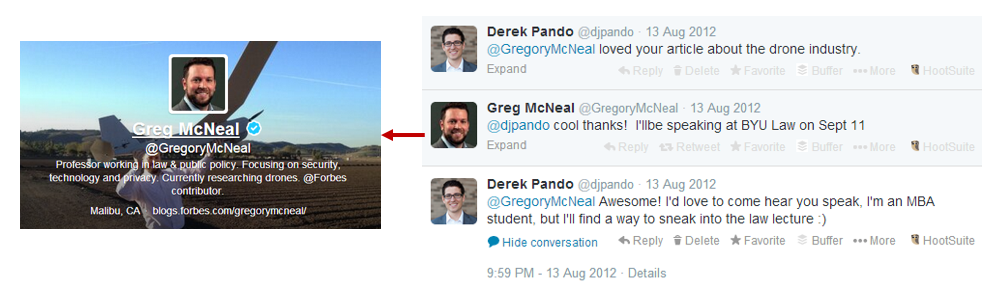 |
| I told a guy on Twitter I liked his article he wrote for Forbes, got to meet him a few weeks later |
Nail the interview. Looking at someone's tweets is a great way to get to know them better as you prep for an interview. Following a company's Twitter handle will help you keep current on the latest things going on with the company. Use all this social information to show in an interview that you are passionate and up to date on what is happening in the industry.
Uncover new job leads. It's not uncommon for users on Twitter to tweet out job openings at their company or on their team. Often it's way before they are posted publicly on job boards. Get a head start and contact the person who tweeted directly to avoid the black hole of applying online. Do searches in Twitter for the titles of the positions you are interested in.
Establish influence. As you participate in the professional community you're interested in on Twitter, you can become a valued member of that community. Contribute to the conversations that are happening around your profession. Over time, if you're thoughtful, people will want to follow you too and hear what you have to say.
Twitter should not be your only job search strategy, but can definitely give you an edge as you pursue your dream job. Please share any questions you have about how students can use Twitter to find a job in the comments.
Subscribe to:
Posts (Atom)