Thursday, April 30, 2015

10 Things You Should Do Before Heading to Business School This Fall

This post was originally published on LinkedIn

Before you hit that pause button on your career and head to two years of business school this fall, there are a few things you might want to consider doing in the next few months to help you hit the ground running.


BYU MBA Tanner building lobby
Jaren Wilkey/BYU

Strengthen your network. Sometimes it’s easier to get meetings with people when you’re already gainfully employed. If you have any contacts at the companies you might want to pursue after business school, you might be better off reaching out now before you leave your current job.

Hold off on some purchases until you get your student discount. There are some steep student discounts on software, Adobe and Microsoft products in particular. You may even want to hold off on buying that new Macbook pro, since being a student is one of the only ways to get discounts on Apple computers.

Spruce up your online identity. Your online presence is going to be an important part of your recruiting, be mindful of your online brand. Take some time to clean up your social media profiles. Add a professional looking picture to LinkedIn and other social networks.

Get copies of past performance reviews. It’s amazing how quickly you can forget about even your own accomplishments. Past performance reviews will give you some great ideas on what to include on your resume, which will be getting quite the makeover in the next few months. Also, it’ll give you ideas of stories and experiences you can share in your upcoming job interviews.

Maximize benefits from your current job. Chances are that your current benefits are better than the student plan or private insurance you’ll have to buy during business school. Go to the dentist for a cleaning and get that last cavity filled. Get a physical to make sure you’re healthy. Lastly, if you wear contacts or glasses, use your full yearly allotment before you quit, to buy back ups.

Do a mini internship. If you’re planning on making a drastic career switch, doing an internship, even if it’s short or unpaid can help you be more marketable for your internship in between your first and second year. Look for an internship that is spot on with the experience you lack.

Prepare your finances. Depending on your situation you might want to speak to an expert, but in general you should think about moving money you know you will need over the next two years out of risky investments and into cash or very stable investment classes. You want that hard earned money to be there for you in a few months when it’s time to write that first tuition check, regardless of unexpected market swings.

Plan a vacation. There are not that many times in your life where you’ll have the ability to take off significant chunks of time for a vacation, penalty free! The few months right before business school is one of those times, plan accordingly.

Start exercising. Chances are you will not create an amazing health and exercise routine during business school without conscious effort. The counterpoint, if you build the habit prior to starting school it will be that much easier to build on it in school and for the rest of your life.

Build in reflection. Everyone has their own method, maybe writing, talking, reading, meditating, or 
listening. One of the advantages of business school is reflecting on both where you are and where you want to be. If you start the habit prior to beginning the program you will not only gain more from the program, you will probably find a more fulfilling and happier version of yourself.

The next two years will probably be some of the most memorable in your life, take the next few months to prepare to hit the ground running to help you find your dream job, have some fun and save some money.

A big thanks to Ben Faw for his help in writing this post.

Wednesday, April 1, 2015

LinkedIn Summary Examples for MBA Students

I've been asked by several MBA students for advice on what to put in their LinkedIn summary. First, if you're thinking about your summary you're on the right track. There are a lot of different ways that you could tackle it, but I wanted to share three examples of profiles that I think have a great summary. As always, this is my personal opinion and not the opinion of LinkedIn.

Also, check out these two articles for more advice on how to write a great LinkedIn summary.

Three Steps To Writing The Perfect LinkedIn Summary
4 Tips for Writing a Compelling LinkedIn Summary

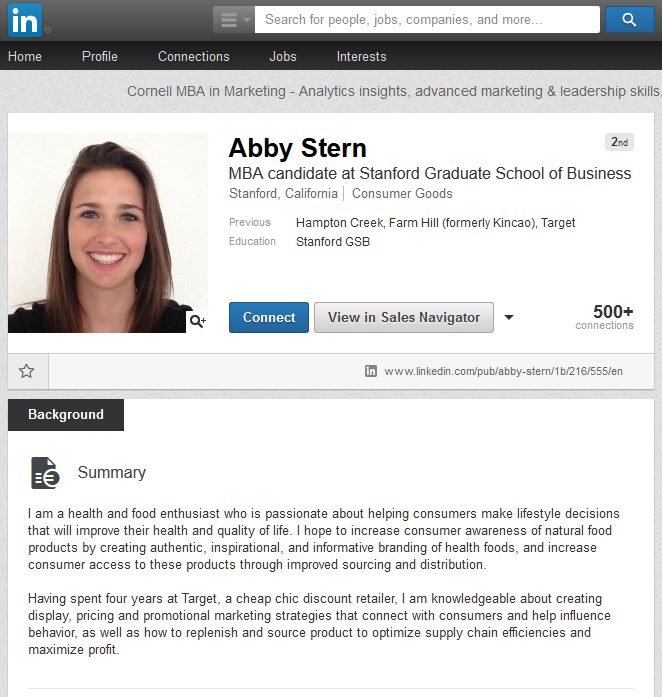
Check out Abby Stern's summary below. She's a a MBA student at Stanford. A quick read of her profile and you have a great sense of what she's passionate about. After her reading her summary it's very clear the sort of companies and roles she is interested in.

LinkedIn Summary Examples MBA students Stanford

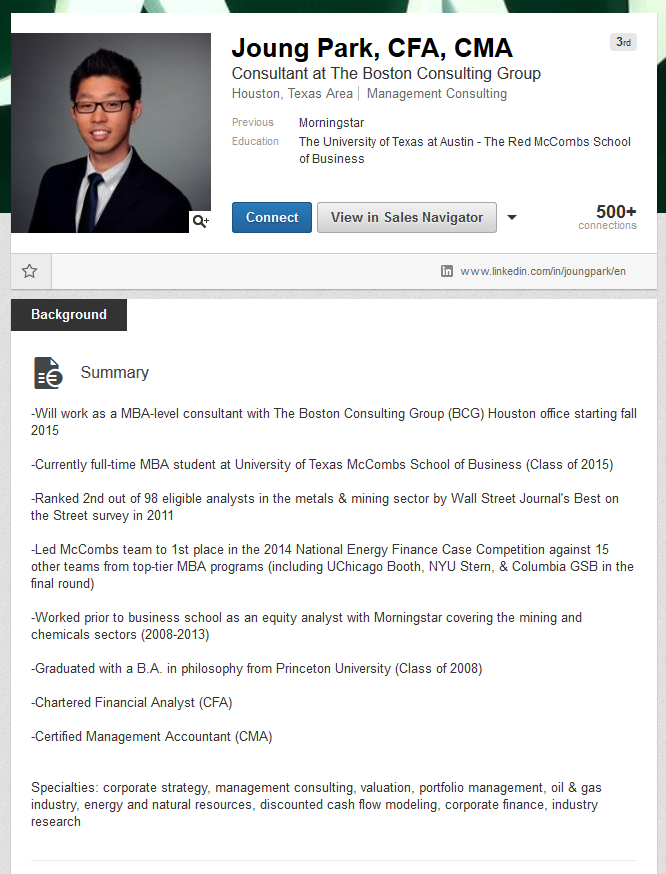
Check out Joung Park's profile below.  He's an MBA student at UT. His summary is really tailored to his finance/consulting audience, it pulls out the highlights from his entire profile with plenty of data points to back it up. 

LinkedIn Summary Examples MBA students university of texas

Check out Tori Dumke's profile. She is a MBA student at BYU. She does a great job of telling her story. She moved from PR to technology marketing, but quickly connects the dots in her summary. In a lot of ways her summary is her elevator pitch. 


LinkedIn Summary Examples MBA students BYU

No matter what angle you take, the best way to improve your LinkedIn summary is to have a few people read it quickly, then tell you what they got out of it. This will help you know if what you'd like to convey to colleagues, recruiters and other professionals is coming through in your summary. If you'd like to learn more about how MBA students can improve their LinkedIn profiles, check out Advanced LinkedIn Tips For MBA Students.

Tuesday, March 17, 2015

Book Summary: Rookie Smarts by Liz Wiseman

If I face the facts, I'm a rookie. I've only been in the workforce 5-6 years and that's only if you count 2 years of business school. I read Liz Wiseman's book Rookie Smarts hoping to get some ideas on how to navigate a fast paced workplace as a rookie and I got exactly that. Here are my high level takeaways.

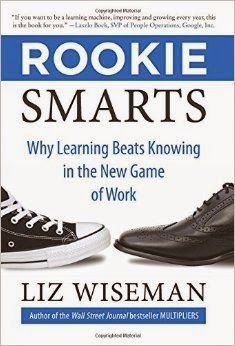
picture of liz wiseman book, rookie smarts


You have more to offer as a rookie than you think. Often, when you're early in your career all you can think about is the experience you don't have and the questions you don't know the answers to. In reality, being a rookie can be a competitive advantage.

Hire an expert....get one expert, hire a rookie, get 5 experts. One of the main advantages we have as rookies is that we don't think we know everything. Our instinct to learn from others when we don't have the answers will actually give us a broader perspective and lots of fresh ideas.

Quick wins are important. If you're in a situation where you're in over your head, look for some quick wins to build momentum, something that can be done in a few weeks.

Take small steps and increase the frequency of feedback. Instead of asking your manager how to do something, consult with experts, do your homework and come back with a recommendation. Do this every few days if needed. If you're checking in for feedback frequently, it's unlikely you'll fall flat on your face with a project since you've had so much time to implement feedback and iterate.

Rookie's need a network to succeed. Rookies are successful because they aren't afraid to leverage those around them. If your network is small, don't worry. Leverage classmates, colleagues and friends. Start building your network by going out to lunch with fellow employees. The bigger the network, the more of an asset it will be to you as a rookie and beyond.

Since I write a lot about the advantages of working in fast growing tech companies early in your career, I just want to point out that if you're in a fast growing tech company you might always feel like a rookie. This book will help you think like a rookie, even when you've got more experience under your belt.

I'm about to take on a new project at work that is definitely going to stretch me. After reading this book, I now have a better understanding on how to make being a rookie into an asset.

Wednesday, March 11, 2015

Silicon Valley's Most Famous Perk is More Than a Free Lunch

This post was originally published on LinkedIn. 

One of the most well known perks that you can find in many Silicon Valley offices is free lunch. At LinkedIn (where I work) this is the case. The lunch that is served at headquarters in Mountain View is superb. I think for those that have never experienced working at a company that feeds you, there are a few misconceptions about the real value of this perk.

Source: Flickr Maaco
Most people think that it's about getting free meals every day. That is certainly convenient.

You might also think it's about saving some $$. I'm always looking for a deal and it's true that I spend less on food because I'm eating lunch at work.

To me though, the real value of a free lunch is the relationships it helps me build and maintain. Here are a few examples.

A few weeks ago I bumped into a senior executive in the kitchen. We had a nice chat, so later that day I emailed him and asked him if he'd like to grab lunch sometime. He said "sounds great" and we got it scheduled right away. Having the food onsite and free makes having lunch with someone else (even senior executives) at the company easy and comfortable.

Every other week or so I eat breakfast with a colleague that works in a completely different part of the company. It's not a scheduled breakfast, we just happen to be getting breakfast at the same time about every other week. There have been many times after chatting about what she's working on, I go back to my desk to chat with my team about how some of the things she's working on will impact our group. This informal channel to share company information breaks down silos that can exist as companies grow.

Our founder, Reid Hoffman, said in The Start Up of You, "one lunch is worth dozens of emails". I'm able to strengthen my relationships not just with coworkers, but with friends and acquaintances that I frequently invite to join me for lunch at LinkedIn. Free lunch and a policy that allows me to bring guests greatly expands the number of people that I can maintain relationships with through this perk.

Free lunch is great, but to me, what matters the most are the relationships you can build over those meals

Wednesday, February 4, 2015

When You Might Not Want to Work for "the man" After Graduation.

This is a guest post by Jon Bradshaw. Jon is the co-founder and CEO of TinyTorch and an adjunct professor at Brigham Young University's Marriott School of Management. He is a huge advocate for entrepreneurship and very involved in the entrepreneurial community in Utah.

Derek is a good friend of mine that graduated from BYU's Marriott School of Business around the same time as I did back in 2008. Since then, we have often debated when the correct time is for someone to walk the path of entrepreneurship.

Derek recently wrote an article called, "Why You Might Want to Work for "the man" After Graduation." He made many solid points that I would like to expound upon. Here is what I recommend you think about if you want to lead a start up, join a startup or get work experience first.

keep calm and hire yourself

Lead a Startup

Out of the hundreds of students that I have taught at BYU, I believe that venturing out on your own is only advisable for about 5-10% of the student population. How do you know if this is you? Here are my thoughts (these are guidelines, and there are always exceptions):

You have always worked for yourself since grade school. You began with a lemonade stand, saved your pennies to build a lawn-service company, and then found bigger and better ideas from there. You have at least two years of real-work experience for the industry that you're wanting to pursue. For tech entrepreneurs, you have a marketable skill like coding or design, which allows you to easily fall back on to help fund your company

Join a Startup

For most graduating students, if you're interested in startups this is the route that I'd recommend. Reasons for this include:

There is no better teacher than a proven entrepreneur starting another company. Your experience here turns into paid training which means that you can make costly mistakes on someone else's dime. Even if you end up working for a dud company, in many ways you'll learn more from a bad entrepreneur than from a seasoned veteran

Get Work Experience First

If you decide to not work for a startup, then go big. Shoot for companies like Salesforce, LinkedIn, Google, or another large tech company. Reasons for this include:

They will pay to train you in many important skills. You will learn how important processes are to making a venture successful, which is something that many entrepreneurs miss. You will get a great paycheck, which you can stash 70-80% into savings, helping you launch a startup later in life. You will develop a strong network, which will help you form partnerships in the future

So after working in startups for 6 years, do I wish that I corporate job? Rarely, but those moments do happen. Watching your friends go on trips to Europe without you, seeing them upgrade to flashy cars, or having the stability to not have to worry about being able to afford the necessities in life would be great. But when I look back at where I've been, and the lessons I've learned, I wouldn't have had it any other way.

Wednesday, January 28, 2015

Why You Might Want to Work for "the man" After Graduation

Obviously I'm terribly biased because this is the path I've chosen. I decided to write this post because in the last few year, I've talked to many undergraduate students who have been bitten by the entrepreneurial bug in a big way. I was exactly the same way. I had started several cash flow positive business in high school so I thought I might as well repeat my success after I get my undergraduate degree.

job after graduation, holding a sign that says "now what?"

That all changed after I worked for a start up during my undergrad. Lets just say I saw the good, the bad and the ugly. Overall it was a positive experience, but the start up crashed and burned. I even saw a hostile takeover that outed the founder. At one point, most employees were working for free in exchange for equity. After I crunched the numbers, I realized that even under the most optimistic circumstances, the equity I owned would not be worth more than one year's salary I could make working for another company.

In my opinion, inexperience, a rogue founder and a poor market assessment led to it's downfall. After this experience, I found an internship with a high growth tech company, which has lead to a career at high growth public tech companies. Here is why I think you should consider working for "the man" after graduation, especially at a high growth technology company.

Marketable skills. Following  this route, you'll likely pick up skills that fit within a job title that will be an asset to you for the rest of your career.

A strong network. With a little efforta strong network of talented people in your field from all functions and levels can be built within a few short years.

Financial stability. Earning competitive wages in the tech industry will not make you a millionaire, but will enable you to save aggressively.

The entrepreneurial spirit is rewarded. At many tech companies having an entrepreneurial spirit is encouraged and even rewarded. You'll be able to climb the ranks faster if you bring that entrepreneurial spirit to your job.

The halo effect. If you go to a start up and it fails, you'll get more credit than you deserve. If you go to a growing company that succeeds, you'll also get more credit than you deserve.

Do I still have the entrepreneurial bug? Of course! Joining a start up or doing my own are still in my future. I believe when that time comes, I'll have the skills, network and emergency fund to have a better shot at being successful.


Monday, January 12, 2015

Building Strong Professional Relationships Starts with the G-Word

This is a guest post by Tom Yang. Tom is in the Leader to Executives Program at T-Mobile. He strives to give more than he receives in all of his professional relationships. He recently graduated with his MBA from the Chicago Booth School of Business. Before attending business school he worked in the automotive industry for Nissan and Mazda. 


You just met someone you feel you could learn a lot from. This person might be a rock star in your industry or just a higher-up at your company. He or she just handed you their business card and suggested you two keep in touch. What do you do now?

Well, the first thing that comes to mind should not be what you can ‘ASK’ of them. Rather, it should be what you can ‘GIVE’ them. The reason for that is simple. The foundation of any relationship is trust. Trust builds over time and through reciprocity. To set reciprocity in motion, start by giving first:


Give Information: Even though information is abundant and easily accessible these days, there is still a shortage of people who can actually draw strategic insights from facts and figures. The next time you send a link of an article to someone, don’t just copy and paste the link to the body of the email without adding detailed context. The better approach would be to write a summary of the article in your own words and communicate why you think the article is relevant to what this person is trying to achieve. He or she will certainly appreciate the thoughtfulness. 

Give Intellect: My favorite question to ask someone whom I admire and want to learn from is “what book would you recommend me”? I ask this question because I believe people recommend books that reveal quite a bit about who they are and what they are passionate about. Once I get the recommendation, I read the entire book from cover to cover. I take copious notes along the way, so I could share what parts of the book resonated with me with the goal of stimulating an intellectual conversation with that person. As a ‘thank you’ gesture, I find another book that is cut from the same thread, read it, and mail a new copy to him or her to continue this virtuous cycle of intellectually invigorating conversations.

Give Inspiration: We all need a little motivation from time to time. We need people to believe in us when we are having trouble believing in ourselves. As such, it is of no surprise that we seem to build stronger bonds with those who were there for us during challenging times. Just recently, an acquaintance informed me that he was planning to apply to his dream business school. Having gone through that arduous process myself, I knew he would need a boost during those early morning, pre-work, GMAT study sessions. I decided to mail him a coffee mug from his dream school to remind him every morning to keep moving towards that goal. This small gesture made a sizable impact and I can say he is currently making strong progress. The key is to find out what people’s aspirations are and support them in a memorable.

Most importantly….

Give Appreciation: I feel the most gratitude during the month of April because that is when TIME magazine releases its list of 100 Most Influential People. This is the period when I reflect on the people who had the most positive influence in my own life in the past year. After I compile a list of 5-8 people, I hand-write a thorough letter to each person expressing the impact he or she had on me. As a final touch, I attach a copy of the special TIME 100 issue along with the letter and send it priority mail. I enjoy doing this every year and I can tell you that people really do appreciate this gesture. As you come up with your own creative ideas, just keep this principle in mind: when someone moved mountains to help you in a major way, that person deserves more than a ‘thank you’ email or text. By showing appreciation in a special manner you move one big step closer towards cementing the relationship.

The old saying, “anything in life that is of value takes time,” rings true in building relationships. I would just add “…and acts of giving” and you have yourself a winning formula.