Monday, September 14, 2015

How to Be Easy to Mentor

In this series, professionals thank those who helped them reach where they are today. Read the posts here, then write your own. Use #ThankYourMentor and @mention your mentor when sharing.
In my first job out of college, there was a reorg where I got a new manager (Dave Kellogg) that I had never met before. He was not just one or two levels above me as you might expect, but a SVP and GM of Salesforce’s Service Cloud business.
I was eager not just to get aligned with my new manager, but to learn from him. I just had one big problem, it was quite challenging to get on his very full schedule. After a few weeks of trying to schedule a few minutes here and there, I had an idea. I thought it was a bit crazy, but I was ready to give it a try. I asked him if I could get a ride with him to work. In a previous conversation, I found out that he lived near me and we both commuted to San Francisco. I remember waiting to hit the send button on the email wondering if I would get a response back with a link to buy a Caltrain pass, but instead he responded, “No problem.”
To make a long story short, I hitched a ride many times to work with Dave. The conversations developed over time from alignment, to Dave providing invaluable advice about marketing, Silicon Valley, business school and how to make everything work while taking care of your family. He is still a mentor today and I am so grateful he was willing to give a ride to a young employee that was eager to learn.
I share this story because I want to thank Dave for being a great mentor, but also to encourage those looking for a mentor to take the initiative. Often, we put too much pressure on our mentor finding and helping us instead of what we can do to be easy to mentor.
To give you a few ideas, I asked three senior executives that I know are great mentors to share what the mentee’s can do to make life easier for the mentor.

“In order to be a great mentee, be proactive and clear about what you want to get out of the relationship with your mentor. Don’t expect the mentor to figure out where to focus your work together, but instead, you should help drive that discussion and be clear about your goals from the outset.”

Shannon Stubo, CMO LinkedIn


“If you want to be easy to mentor you need to...

  1. Prepare: come to a meeting ready and armed with 1-3 pithy questions.

  2. Listen non-defensively: defensiveness kills communications. If you're always interrupting and explaining (e.g., "but we only had one week to get that done"), it means you're not listening

  3. Act: put the ideas in practice and come back with feedback and questions based on those actions.


Most mentors love teaching, so being easy to mentor means becoming a good student.  Good students come prepared, are motivated to learn, do their homework, and challenge their teachers.  It’s a win/win relationship where both parties learn from each other.  On the flip side, nothing is worse for a mentor than someone who’s just going through the motions and not genuinely interested in learning. After I’ve given the same feedback twice, if the person hasn’t tried anything or changed anything, then it’s time to move on.  It’s a waste of everyone’s time if you don’t really want to change and learn."

Dave Kellogg, CEO Host Analytics 


“In my experience, each member of the mentoring partnership contributes to the relationship and shares responsibility for its effectiveness. Both the mentee and the mentor learn and benefit from the experience. I have found that the best relationships occur when both mentor & mentee establish a mutually beneficial partnership where they can OFFER and GIVE during each engagement.”

Shawn Bryant, VP American Express


To all my mentors past and present, thank you!
This post was originally posted on LinkedIn.

Friday, July 10, 2015

6 Important Financial Steps to Take After Having a Baby

So.....according to CNN it will cost $245,000 to raise a child in the US. While that sounds a little high, it's a for sure thing that having a child is going to increase your expenses. Ever since my wife got pregnant, I've been thinking about how our little one might impact our finances and what I can do to prepare. After researching the topic, I think there are 6 basic financial steps you need to take after you have a baby. 


picture of baby with money


Add the baby to your insurance. If you have insurance through your company, many insurance providers will require that you do it within 30 days of the little guy or girl being born. Do this on time to make sure hospital expenses for the baby will be covered and you'll have continued coverage

Update your W-2. There are some serious tax breaks for having a child, why wait until the end of the year to get them and let Uncle Sam earn interest on your hard earned money? Update your withholding to put more money in your pocket now. Use this calculator to help figure out what the right amount of withholding might be for your situation.

Buy life insurance. If you already have it, you might want to increase it, especially if you are the primary bread winner. If something were to happen to you, you would not want to put your spouse and child in such a difficult financial position.

Open a 529 College Savings account. No matter what higher education looks like in 18 years, it'll probably cost money. 529 savings accounts are a fantastic way to grow college savings for your little one tax free. Check out this Forbes article with details.

Create a will. This one is no fun to talk about, but do you really want to leave it up to a state government to decided what happens to your child and assets in the worst case scenario that something happens to you and your spouse.

Re-do your budget. There are new expenses, new tax breaks and now you're saving for your child's college. It might be a good time to revisit your budget and make sure everything is aligned.

If you think I might have missed any important steps, please add them in the comments!

Saturday, June 27, 2015

I Watch Telenovelas to Improve my Spanish

My wife and I both speak Spanish fluently, but admittedly, we don't speak it that often. Ever since we got pregnant last year, we decided that we are going to make an effort to teach our son Spanish once he was born. This has been a challenge since it feels a little forced for us to speak to each other in Spanish. We've been experimenting with other ways to improve our Spanish in preparation for his arrival.  Our current favorite is watching Telenovelas. Here are a few reasons we like this option.


Image of telenovela we are watching to improve our spanish
It's easy. There were plenty of free options for Telenovelas on Hulu that we can watch on demand.

It's entertaining. I don't think we'd be watching it if we were not trying to improve our Spanish, but it's reasonably entertaining. Definitely better than studying some book, or flashcards.

It's helping with comprehension. We are hearing native speakers speak at their normal speed. We've already seen improvements in our comprehension.

It's expanding our vocabulary. As we are watching the show we'll look up words that we don't understand. We quickly learned the words "chantajear", "asesino" and many others.

The only downside so far has been that watching does not get us speaking. Expanding our vocabulary and comprehension is important, but we need to do more to speak. I'd love to hear ideas about others do to keep up with their languages skills.


Saturday, June 13, 2015

5 Reasons to Have a Waffle Party

Having waffles as the center piece to any social occasion is bound to be successful. I recommend them for weddings, birthdays, bar mitzvah's and single Mormon gatherings for the following reasons.


1. Who does not like a waffle? Are waffles more universally loved than pizza? Probably.

2. You can feed a crap load of people for almost nothing.  In fact, you can even rent your high end waffle maker out when you're not using it to pay for your luxurious lifestyle. It pays for itself!

3. People can bring stuff and it's really easy. Even your one friend who never thinks ahead and usually shows up empty handed to such gatherings might show up with a half used bottle of strawberry jam, and that's OK.


4. You can keep waffle supplies on hand at all times. All you need is waffle mix that is shelf stable for 70 years and water. This comes in very handy for unexpected guests or a zombie apocalypse.


5. Waffles start friendships. This guy and I became friends at a waffle party, it's true, no matter what Kevin Chesnos or one of his kids says.


A big thanks to Brad and Mandy Morris for giving us an epic waffle maker for our wedding.

Thursday, April 30, 2015

10 Things You Should Do Before Heading to Business School This Fall

This post was originally published on LinkedIn

Before you hit that pause button on your career and head to two years of business school this fall, there are a few things you might want to consider doing in the next few months to help you hit the ground running.


BYU MBA Tanner building lobby
Jaren Wilkey/BYU

Strengthen your network. Sometimes it’s easier to get meetings with people when you’re already gainfully employed. If you have any contacts at the companies you might want to pursue after business school, you might be better off reaching out now before you leave your current job.

Hold off on some purchases until you get your student discount. There are some steep student discounts on software, Adobe and Microsoft products in particular. You may even want to hold off on buying that new Macbook pro, since being a student is one of the only ways to get discounts on Apple computers.

Spruce up your online identity. Your online presence is going to be an important part of your recruiting, be mindful of your online brand. Take some time to clean up your social media profiles. Add a professional looking picture to LinkedIn and other social networks.

Get copies of past performance reviews. It’s amazing how quickly you can forget about even your own accomplishments. Past performance reviews will give you some great ideas on what to include on your resume, which will be getting quite the makeover in the next few months. Also, it’ll give you ideas of stories and experiences you can share in your upcoming job interviews.

Maximize benefits from your current job. Chances are that your current benefits are better than the student plan or private insurance you’ll have to buy during business school. Go to the dentist for a cleaning and get that last cavity filled. Get a physical to make sure you’re healthy. Lastly, if you wear contacts or glasses, use your full yearly allotment before you quit, to buy back ups.

Do a mini internship. If you’re planning on making a drastic career switch, doing an internship, even if it’s short or unpaid can help you be more marketable for your internship in between your first and second year. Look for an internship that is spot on with the experience you lack.

Prepare your finances. Depending on your situation you might want to speak to an expert, but in general you should think about moving money you know you will need over the next two years out of risky investments and into cash or very stable investment classes. You want that hard earned money to be there for you in a few months when it’s time to write that first tuition check, regardless of unexpected market swings.

Plan a vacation. There are not that many times in your life where you’ll have the ability to take off significant chunks of time for a vacation, penalty free! The few months right before business school is one of those times, plan accordingly.

Start exercising. Chances are you will not create an amazing health and exercise routine during business school without conscious effort. The counterpoint, if you build the habit prior to starting school it will be that much easier to build on it in school and for the rest of your life.

Build in reflection. Everyone has their own method, maybe writing, talking, reading, meditating, or 
listening. One of the advantages of business school is reflecting on both where you are and where you want to be. If you start the habit prior to beginning the program you will not only gain more from the program, you will probably find a more fulfilling and happier version of yourself.

The next two years will probably be some of the most memorable in your life, take the next few months to prepare to hit the ground running to help you find your dream job, have some fun and save some money.

A big thanks to Ben Faw for his help in writing this post.

Wednesday, April 1, 2015

LinkedIn Summary Examples for MBA Students

I've been asked by several MBA students for advice on what to put in their LinkedIn summary. First, if you're thinking about your summary you're on the right track. There are a lot of different ways that you could tackle it, but I wanted to share three examples of profiles that I think have a great summary. As always, this is my personal opinion and not the opinion of LinkedIn.

Also, check out these two articles for more advice on how to write a great LinkedIn summary.

Three Steps To Writing The Perfect LinkedIn Summary
4 Tips for Writing a Compelling LinkedIn Summary

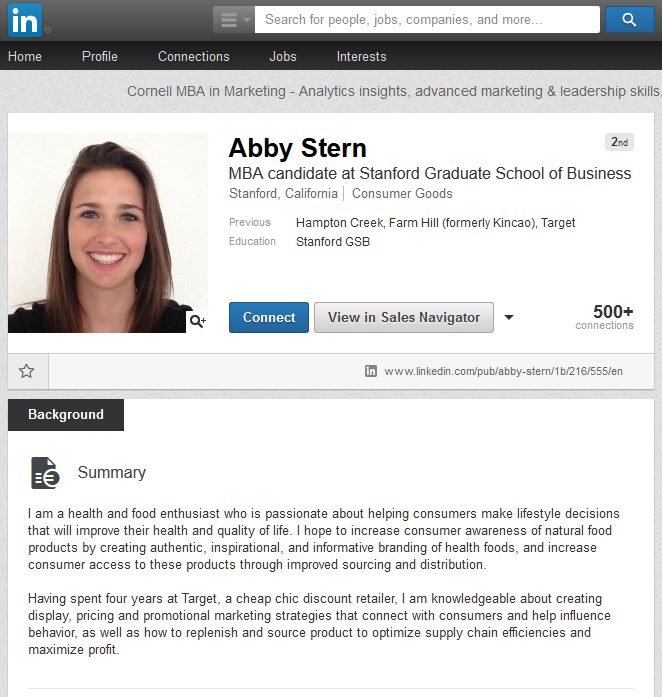
Check out Abby Stern's summary below. She's a a MBA student at Stanford. A quick read of her profile and you have a great sense of what she's passionate about. After her reading her summary it's very clear the sort of companies and roles she is interested in.

LinkedIn Summary Examples MBA students Stanford

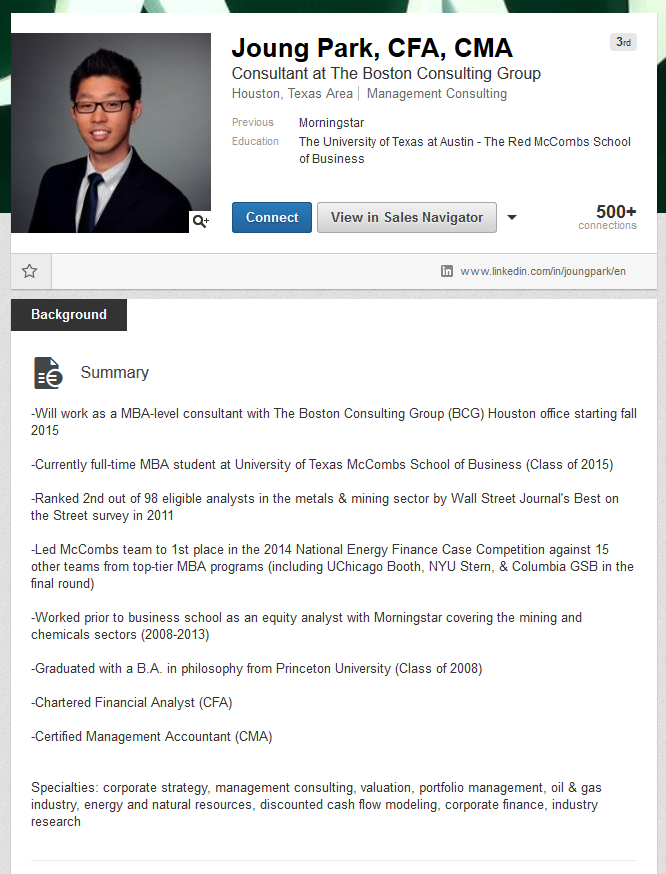
Check out Joung Park's profile below.  He's an MBA student at UT. His summary is really tailored to his finance/consulting audience, it pulls out the highlights from his entire profile with plenty of data points to back it up. 

LinkedIn Summary Examples MBA students university of texas

Check out Tori Dumke's profile. She is a MBA student at BYU. She does a great job of telling her story. She moved from PR to technology marketing, but quickly connects the dots in her summary. In a lot of ways her summary is her elevator pitch. 


LinkedIn Summary Examples MBA students BYU

No matter what angle you take, the best way to improve your LinkedIn summary is to have a few people read it quickly, then tell you what they got out of it. This will help you know if what you'd like to convey to colleagues, recruiters and other professionals is coming through in your summary. If you'd like to learn more about how MBA students can improve their LinkedIn profiles, check out Advanced LinkedIn Tips For MBA Students.

Tuesday, March 17, 2015

Book Summary: Rookie Smarts by Liz Wiseman

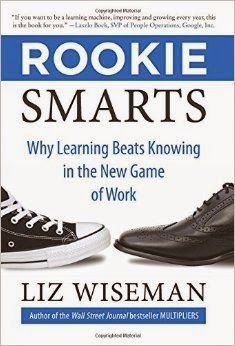
If I face the facts, I'm a rookie. I've only been in the workforce 5-6 years and that's only if you count 2 years of business school. I read Liz Wiseman's book Rookie Smarts hoping to get some ideas on how to navigate a fast paced workplace as a rookie and I got exactly that. Here are my high level takeaways.

picture of liz wiseman book, rookie smarts


You have more to offer as a rookie than you think. Often, when you're early in your career all you can think about is the experience you don't have and the questions you don't know the answers to. In reality, being a rookie can be a competitive advantage.

Hire an expert....get one expert, hire a rookie, get 5 experts. One of the main advantages we have as rookies is that we don't think we know everything. Our instinct to learn from others when we don't have the answers will actually give us a broader perspective and lots of fresh ideas.

Quick wins are important. If you're in a situation where you're in over your head, look for some quick wins to build momentum, something that can be done in a few weeks.

Take small steps and increase the frequency of feedback. Instead of asking your manager how to do something, consult with experts, do your homework and come back with a recommendation. Do this every few days if needed. If you're checking in for feedback frequently, it's unlikely you'll fall flat on your face with a project since you've had so much time to implement feedback and iterate.

Rookie's need a network to succeed. Rookies are successful because they aren't afraid to leverage those around them. If your network is small, don't worry. Leverage classmates, colleagues and friends. Start building your network by going out to lunch with fellow employees. The bigger the network, the more of an asset it will be to you as a rookie and beyond.

Since I write a lot about the advantages of working in fast growing tech companies early in your career, I just want to point out that if you're in a fast growing tech company you might always feel like a rookie. This book will help you think like a rookie, even when you've got more experience under your belt.

I'm about to take on a new project at work that is definitely going to stretch me. After reading this book, I now have a better understanding on how to make being a rookie into an asset.