Monday, March 17, 2014

How To Get Great Work Experience While You Are In College

When I was in college, I organized a Guinness world record breaking rock paper scissors tournament as a fundraiser for my university’s entrepreneurship club. To promote the event we had a helicopter land on campus, parked a Lamborghini in the quad and got the volleyball team to act as the referees for the tournament. It was a ton of work and a ton of fun.

Would it surprise you if I told you that being in the leadership of that club and running that tournament helped put me on the path to landing a great full time job when I graduated? The skills I learned from running that tournament and the exposure to the local business community it created, helped me get my first internship. That internship led to a better internship, which led to a great full time job.

These days companies seem to have higher and higher expectations for the skills that grads have coming out of college. It is important to get good grades, but having valuable experience AND a diploma is more frequently the recipe for success when it comes to finding a job after graduation. Below are 10 ways students can get great work experience.

Picture of the omniture throwdown a BYU fundraiser


1. Do an Internship- Internships can often lead to a job or at least provide you with skills that will help you get a job later.

2. Volunteer- Getting paid is not a requirement to count as work experience. Often volunteer work can be done on a project basis or maybe over a holiday break.

3. Get involved in clubs- Don’t just go for the pizza, get involved in the leadership of the clubs that interest you. This will increase your visibility and access to the club’s network.

4. Get a part time job- Not only does it pay the bills, but can help make you be more marketable for after graduation. Try to find something that could be a stepping stone towards your post graduation plans.

5. Look beyond your current role- Leverage your current job to get exposure to other parts of the company that might interest you. Offer to help another department with a side project to learn a skill you need.

6. Work for a start up- They are often are fast moving, exciting and willing to give you more responsibility than you should have as a student.

7. Take the right classes- This could be a class that gives you hard skills, like an advanced excel class. It could also be a field study or an on campus internship. Select your classes with a future job in mind.

8. Participate in competitions- It could be a film competition or a business case competition. Often the sponsors of competitions for students are interested in hiring students. Take the chance to show them what you got.

9. Start your own business- Can’t find someone to hire you? Have a great idea? Don’t wait around. Try it on your own.

10. Teach yourself the skills you need- There are many skills that can be self taught. Read a book or watch “how to” YouTube videos. Connect with professionals that currently have those skills to get ideas how to develop them on your own time.

Those four years will be over before you know it. Don't forget to take the time now to make sure that you graduate with a diploma and a resume. Make sure that each semester, whatever you are doing outside of the classroom, is getting you one step closer to your dream job.

Monday, March 10, 2014

How Students Can Use Twitter To Find a Job

In 2009, I graduated from my undergrad with zero full time job prospects. I ended up taking a post graduation internship at Adobe (Omniture at the time). During my internship I started to follow the web analytics community on Twitter. I was looking for a full time job and happened to see one of the industry experts (Adam Greco) post a tweet saying he was looking for candidates with Omniture experience for a job in San Francisco. I reached out to him immediately. Six weeks later, I was driving across the bay bridge to start my career in San Francisco.

Twitter can be a powerful tool to help you find a job. Below are some ways that students can use Twitter to help them find a job. You can use Twitter to.....

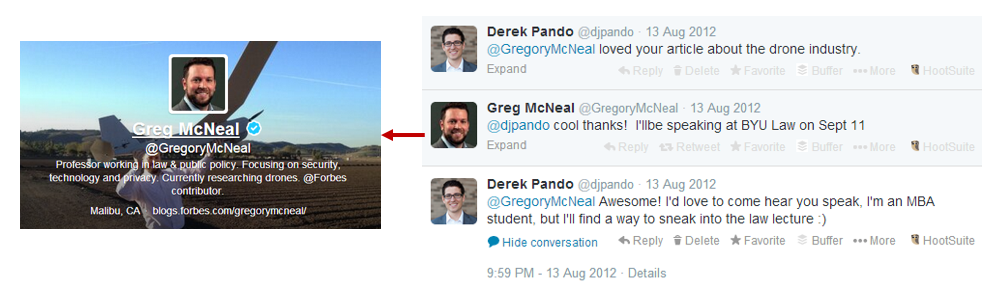
Build new relationships. Follow people that you would like to get to know. Respond to their public questions or comment on articles they share. You'll be surprised at who will respond back to one of your thoughtful tweets. Twitter is a great place to start a relationship.

example of a conversation on twitter with Greg Mcneal
I told a guy on Twitter I liked his article he wrote for Forbes, got to meet him a few weeks later

Nail the interview. Looking at someone's tweets is a great way to get to know them better as you prep for an interview. Following a company's Twitter handle will help you keep current on the latest things going on with the company. Use all this social information to show in an interview that you are passionate and up to date on what is happening in the industry.

Uncover new job leads. It's not uncommon for users on Twitter to tweet out job openings at their company or on their team. Often it's way before they are posted publicly on job boards. Get a head start and contact the person who tweeted directly to avoid the black hole of applying online. Do searches in Twitter for the titles of the positions you are interested in.

example of hubspot posting a job on twitter


Establish influence. As you participate in the professional community you're interested in on Twitter, you can become a valued member of that community. Contribute to the conversations that are happening around your profession. Over time, if you're thoughtful, people will want to follow you too and hear what you have to say.

Twitter should not be your only job search strategy, but can definitely give you an edge as you pursue your dream job. Please share any questions you have about how students can use Twitter to find a job in the comments.


Monday, March 3, 2014

Advanced LinkedIn Tips For MBA Students

*While I'm writing this from the perspective of an MBA student, all these LinkedIn tips work for any sort of student.

You've mastered the basics of LinkedIn. Your profile is filled out. You've stopped connecting with strangers. You always send a personalized message when you connect. What's next? Below are my advanced tips for students who want LinkedIn to be a competitive advantage for them in finding a job and managing their career.

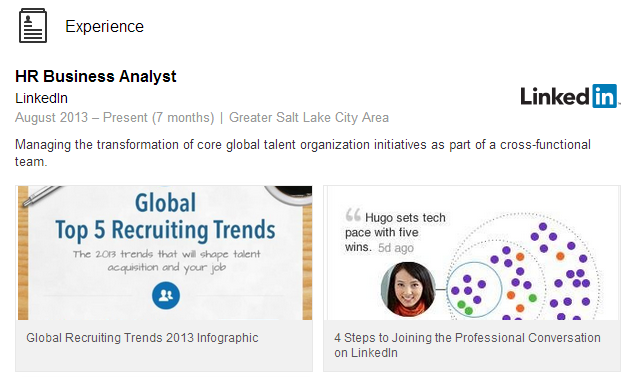
1. Embed work that you've done. It's your reputation, not your resume. Show everyone what you can do. If you have any examples of your work that you're proud of, put them under the job where you created it. LinkedIn lets you embed videos, Slideshare and links to webpages.

Image of some presentations embedded in a LInkedin profile


2. Create profiles in other languages you speak. I wrote another post about why you should do this. You can read it here. It's easy to create a profile in another language in LinkedIn.

"hello" word cloud in multiple languages

3. Optimize your profile for the right keywords. Make sure the key words you want to be found for are in your profile. LinkedIn works a lot like a search engine. If the words or job titles you want to be found for are not in your profile, you'll be hard to find.

Screenshot of the linkedin search bar

4. Join groups strategically and participate. Join groups that are the watering holes of the people you want to be associated with. Jump in on the conversations that are interesting. Groups are a great way to show expertise and build new relationships.

5. Automate some of your sharing. I've found that it is a lot easier to share content on LinkedIn if you use a tool like Buffer. Consistent sharing of relevant content about your industry will keep you top of mind in your network. Buffer queues up articles so they are shared in the future. For example, you can have a post go out every Monday at 3:00 pm. If you find 7 articles you'd like to share one morning, you can have them easily scheduled to go out over the next 7 days. The advanced scheduling helps you be consistent and saves you the hassle of trying to find a new article to share everyday. Check out this article from Buffer on how it works.

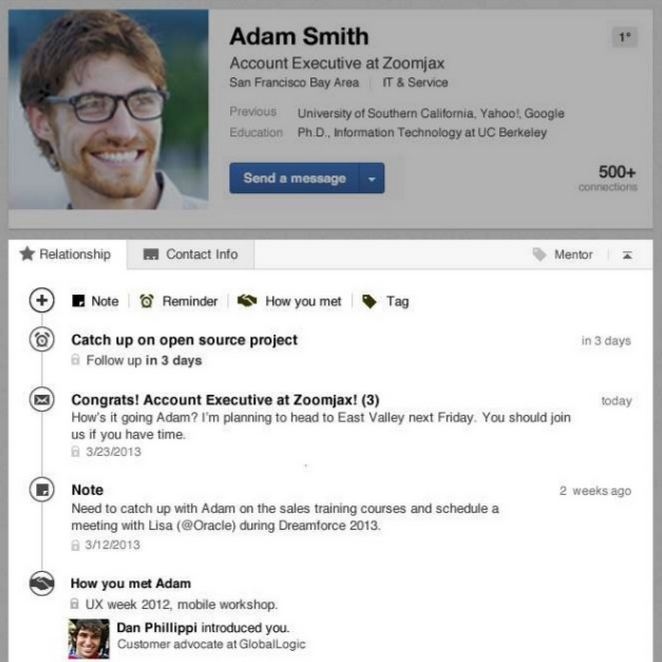
6. Sign up for advanced contacts functionality. Go to contacts.linkedin.com, hit the "get started" button. As you go through the sign up process, don't forget to sync LinkedIn with your email and calendar. For more details on what these features can do, check out this article from Hubspot on how to use LinkedIn contacts. As an MBA student, these features will save you countless hours as you use LinkedIn to build your network and find a job or internship.

Screenshot of the email integration with Linkedin contacts

7. Get recommendations- I recommend getting one or two for each major role. While it's tempting to get them from a fellow MBA student, try to get recommendations from professionals you worked with in your jobs.

8. Manage your endorsements- If you are getting endorsed for something you don't want to be endorsed for, take it down. Check out this article to learn how to do it. If there is something you'd like to be endorsed for, send an email to a bunch of fellow MBA students or a small trusted group of friends/colleagues asking them to endorse you. Definitely do not SPAM everyone you know asking for an endorsement. Also, only ask to be endorsed for skills that you legitimately feel you have some expertise in.

List of LinkedIn endorsements


I hope you've enjoyed these advanced LinkedIn tips for MBA students. If you have done all these things, you are well on your way to becoming an LinkedIn expert. If you missed my first post on this topic LinkedIn Basics For MBA Students, click the link to get the basics down before you try all the steps I've outlined above. If you're looking for more tips on how to write your LinkedIn summary check out LinkedIn Summary Examples for MBA Students. If you have any other questions, please comment below. Also, if you have some advanced LinkedIn tips I'm missing, I'd love to hear about them.

Monday, February 24, 2014

An Easy Way To Take The Awkwardness Out Of Networking

There can be awkward moments when you are trying to build your professional network. It's hard to know what to say to start trying to build a professional relationship with someone. I've found though, that there is one simple question that can really help jump start a relationship in a lot of situations.

Could you tell me about how you got to where you are?

In other words, you're asking someone to share their story. It's usually insightful, maybe inspiring, but everyone has a story and often people are not afraid to share it. There is also something personal about hearing about the long and sometimes windy trail that has lead to their current endeavors. This question can be very natural especially if you're young in your career or a student.

picture of a quote "we all have a story to tell"


I interned at Adobe when I was an undergrad. I met with an executive in another department to get some advice as I was still figuring out what I wanted to do for my career. I asked that one question (with a few follow up questions, of course) and we talked for 30 minutes. At the end of the conversation she asked if she could help me by introducing me to other people in the company. She asked me! There is something about telling someone your own story that often inspires you to lend a hand. Now, I'm not writing this so you can ask this question and try to flatter someone into helping you. That is not my intention. I just want you to know that it's a common outcome to asking this question. The most valuable thing you'll get out of asking that question is getting to know someone better and being inspired by their story.

Monday, February 17, 2014

Negotiating Tips For People Pleasers

I'll admit it. I'm sort of a people pleaser. I'm not a complete push over, but I highly value harmony in my personal  and professional life. This past year in business school I've taken two negotiation classes that I've really enjoyed. In the classes, when we would do mock negotiations, it became painfully obvious to me that my people pleasing can get me a terrible deal in a negotiation. Here are my top tips I've learned to help people pleasers like me not get a raw deal in negotiations.

Guy smiling holding a piece of paper that says yes


Prepare. If you do your homework beforehand, you'll know when you get past the point a deal is worth it for you. (This is called a BATNA...google it to learn more). You can be confident going into a negotiation that you have a very strict walking away price and won't let your need to find harmony put you in a worse situation than where you started.

Team up. Bring someone into the negotiation that likes a little bit of conflict. It will balance you out and keep you in check if you're settling too quickly.

funny meme about partnership, showing a bear fishing with a person

Avoid in-person meetings.  If you tend to cave when you're in person, send a proxy, do it over the phone or maybe even email. It's really easy to hold your ground when you're not there in person. It's harder to read social cues through those mediums, but it might be worth it for a people pleaser.

Be optimistic. For a lot of people pleasers, this just makes you more comfortable. In tough situations, remind whoever you are negotiating with that you are still optimistic you'll be able to reach a deal.

Eagle trying to carry away a huge turtle


Take a timeout. It's like a timeout in basketball, if you feel the heat from the other side and it makes you want to settle, just kill the momentum by taking a break. If you're on the spot, say you need a class of water or need to go to the bathroom.

a nba player trying to call a timeout from the floor

Negotiating well is a skill. Even if it does not come naturally, with effort and a little bit of practice, you can greatly improve your skills. If you want to learn more, I recommend "The Truth About Negotiations" by Leigh Thompson

Cover of truth about negotiations book by Leigh Thompson


Monday, February 10, 2014

Why You Want To Make Introductions For Your Professional Network

You just got an email from a friend asking for an introduction to one of your connections. Should you ignore it? Pretend you don't know them? Wait 6 months to reply, then tell them it got sent to SPAM?

I'd like to make my case on why you usually want to do it.

The inspiration for this post came from a great article Reid Hoffman wrote called Help the People You Know with Small Gifts. In the article he explains that "the best way to strengthen a relationship is to jump-start the long-term process of give-and-take." He goes further to say that "pleasant friendships are nice, but the best-connected professionals are ones who can really help their allies. This is what makes a professional network and not simply a social one."

Picture of Reid Hoffman at LinkedIn


Generally speaking, introductions do not take a lot of time. At most, it'll take a few minutes to fire off a few emails. Those few minutes though, could change someone's life. A few months ago a former roommate asked if I'd introduce to him to one of my friends that works at Facebook. He wanted to abandon his career in academia to become a Data Scientist. I thought he was smart and talented, so I made the introduction. It took me less that 5 minutes. A few weeks later, I saw he accepted a job with Facebook. In a few minutes I created immense value for two people. My friend got a new job and the person I introduced him to got a great new colleague and probably a fat referral bonus.  

Particularly with introductions, I find that what goes around comes around. It's always a pleasant feeling to send an email asking for an introduction, knowing you were able to help them when they were in a similar situation a few months ago. Don't make the introduction though, if you feel you'd have to get something in return later to feel satisfied. It's best to do it with no expectation for return, then be pleasantly surprised later.
two hands shaking in greeting

There is a caveat though, don't do it if you don't respect and trust the person you are making the introduction for. Look for opportunities to facilitate mutually beneficial relationships.

Whether you're making an introduction to help someone find a job, close a deal or just get some great advice take the time to make it happen.


Monday, February 3, 2014

How To Network Without Being Annoying, Phony or Fake

My brother really hates "networking" in the negative stereotypical sense of it. He does not like going to networking events. His nightmares involve approaching random people and asking for favors, but guess what, he has done an amazing job at building his network since he graduated from college.

A picture of Punch Drunk Mustache artists at comicon including Sean Pando
My brother is the one in the middle with the white shirt

All he does is one simple thing, he participates in his profession.

Let me explain. My brother is a talented concept artist who has worked for the likes of Lucasfilm. Check out his blog here. When he started his job at Lucasfilm out of school, he really wanted to learn from the talented artists that surrounded him. He did whatever he could to participate in what the other talented artists he worked with were doing. Those activities varied greatly. Sometimes that meant he was doing crossfit during lunch with his coworkers. Other times it meant he was attending evening classes sponsored by the company on different art topics. It also meant he would attend screenings of the shows from other departments (tough life, right?) Through all of these activities he got to know some coworkers that were going to do a concept art book. He got invited to participate. Next thing you know, he's launching a concept art book with some of the industry's best. Check out his book called Punch Drunk Mustache here. Below are a few images from his book.


concept art picture of a tree frog landscape
Credit: Sean Pando

Concept art picture from amy beth
Credit: Amy Beth

Contributing to the book has provided even more opportunities for him, like attending Comicon in San Diego last year for his book launch. Expanding his network beyond just the people he worked with directly has created many freelance opportunities for him.

If networking is difficult or scary for you. Don't do it. Just participate in your profession. Find the watering holes of  the people you aspire to be like and just show up. If you do this, you will naturally expand your network and possibly your skills. So, just get out there and find those watering holes.


A picture of animals in africa around a watering hole

If you want to learn more check out this video where I talk about this concept.